bodhi (awakening) · orchard (a tended grove)
Agent-Driven Development.
The modern alternative to sprint, scrum, and agile.
Bodhiorchard is the open-source reference implementation — 12 specialised AI agents from conversation to production, self-hosted on your hardware, with your choice of inference engine.
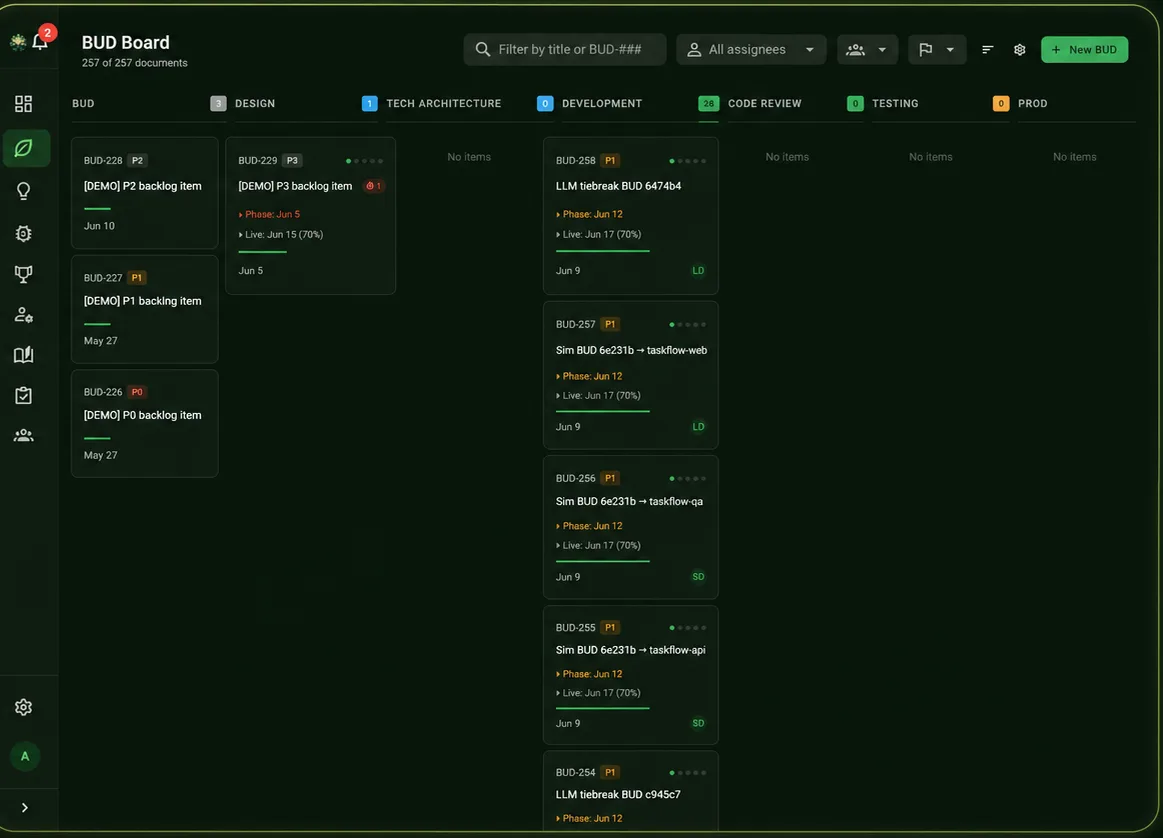
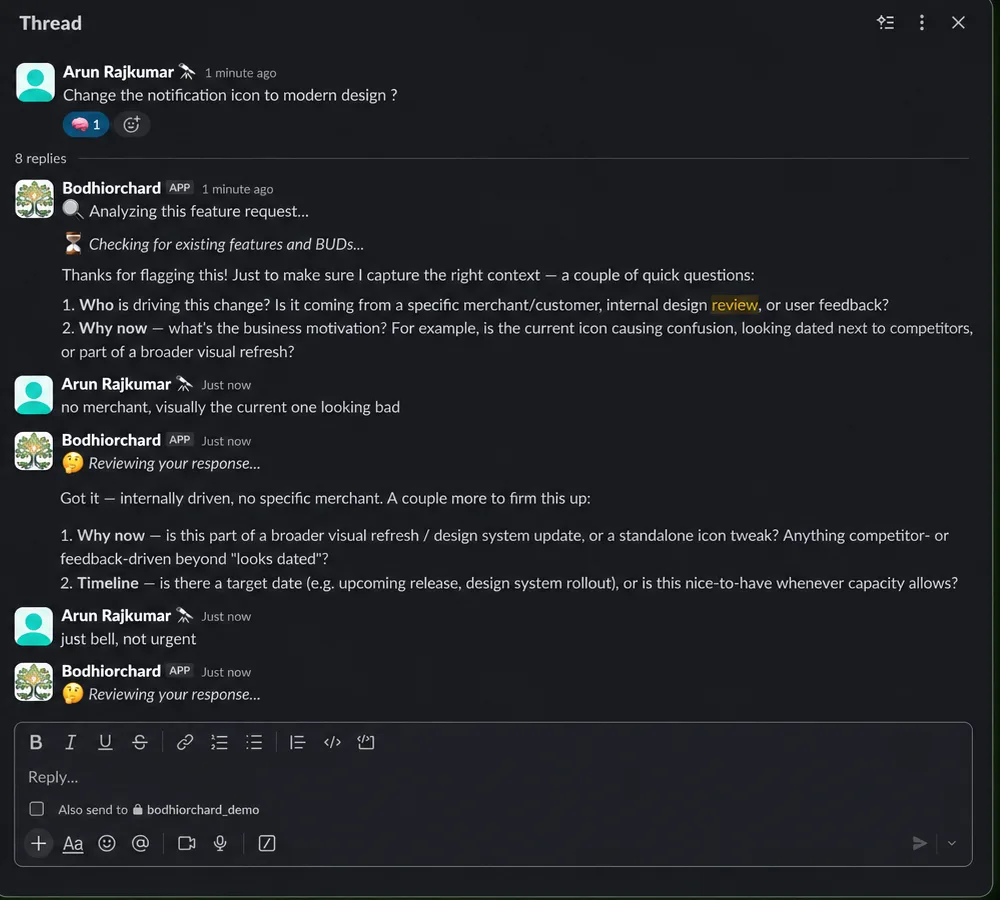
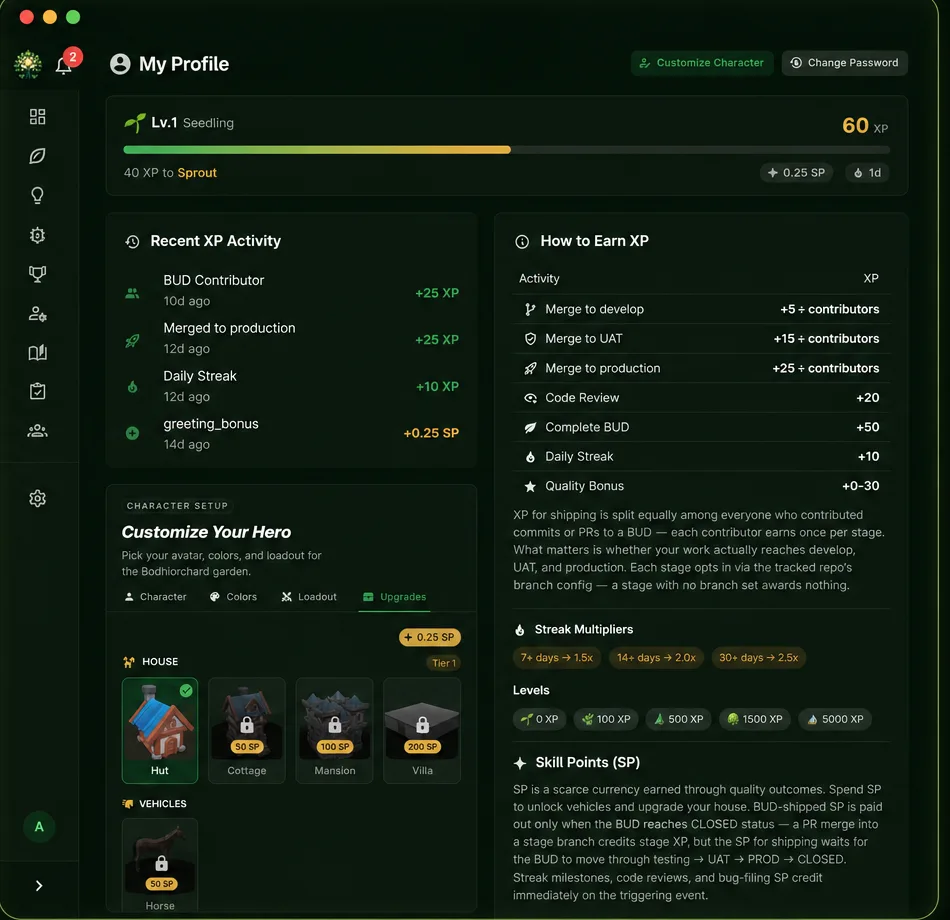
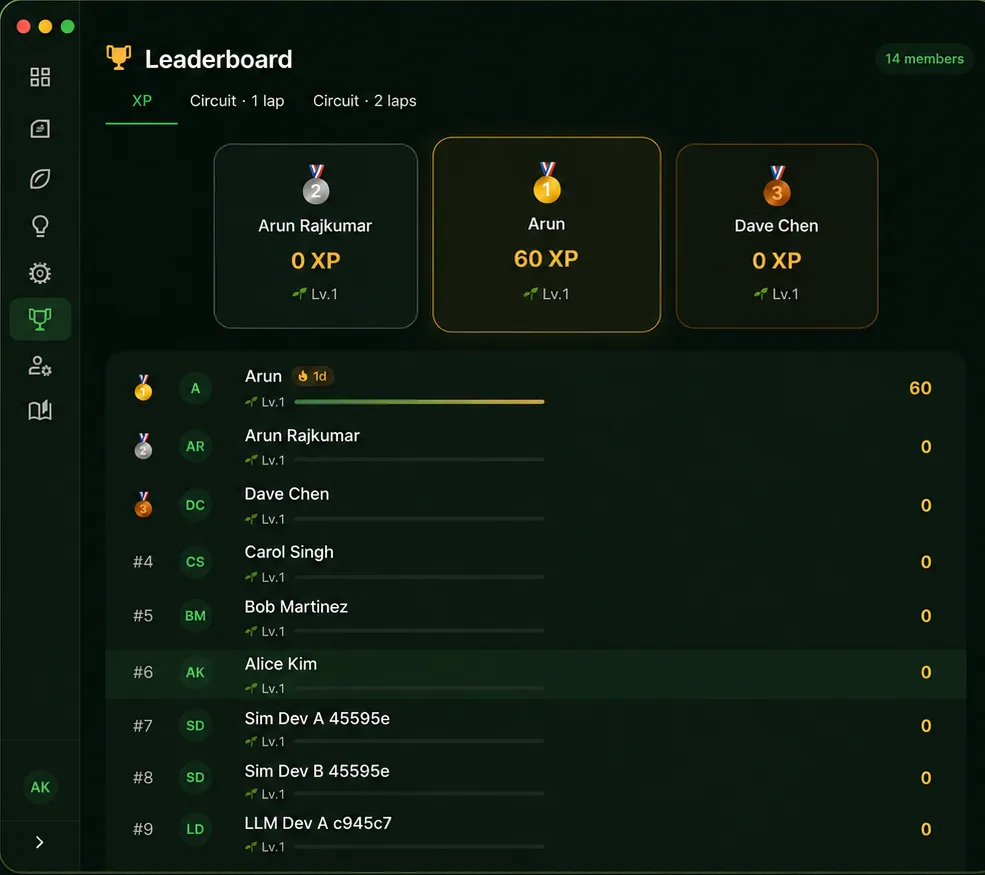
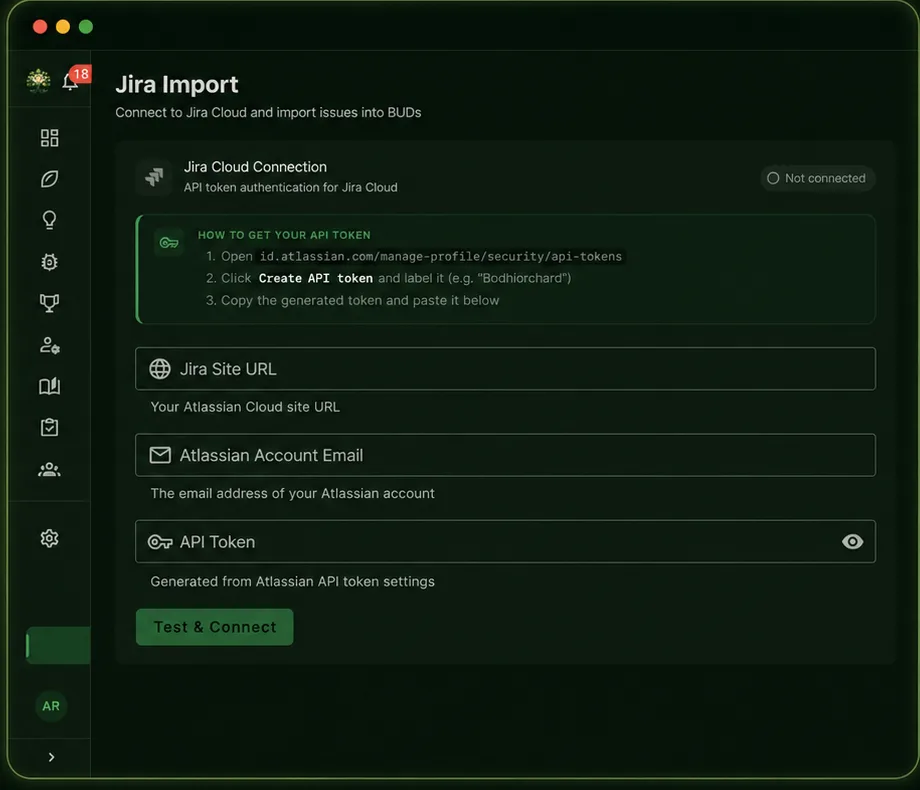
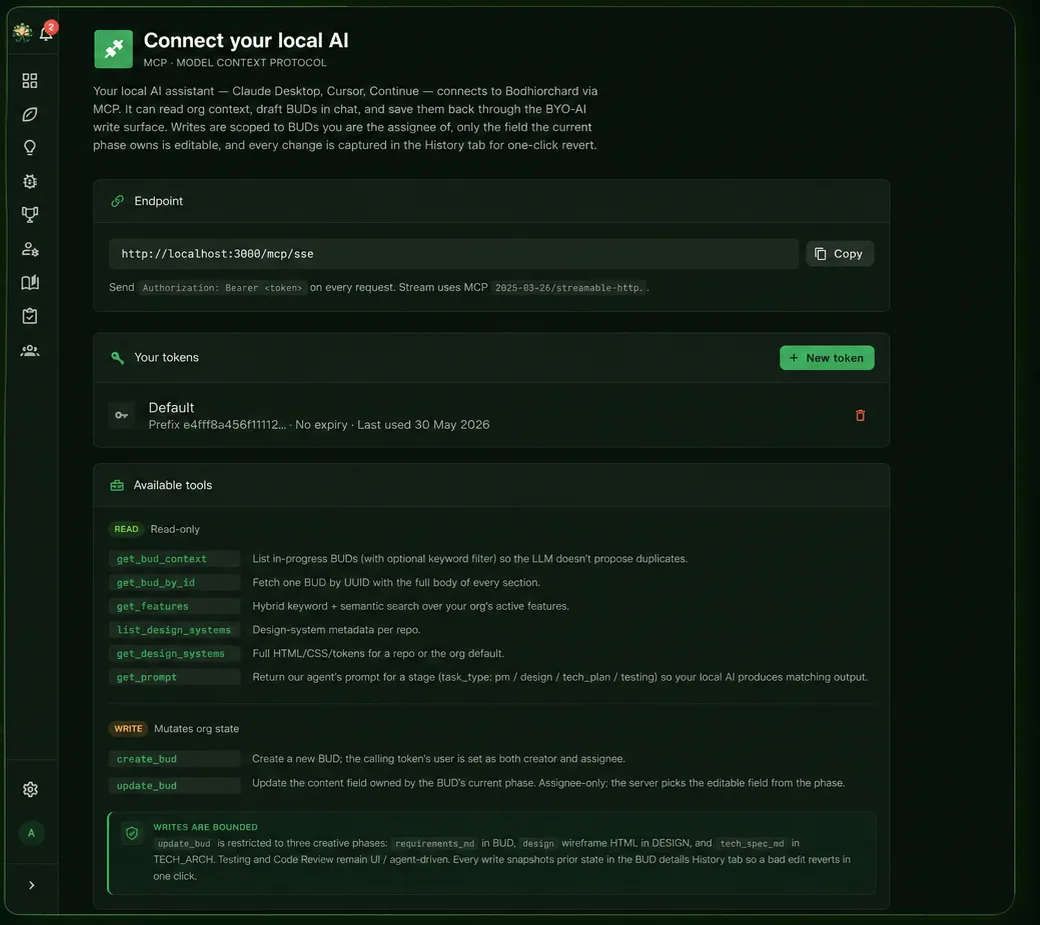
Three views of the same platform: the 3D Living Tree of your code, the BUD board, and the Slack triage that turns chatter into specs.
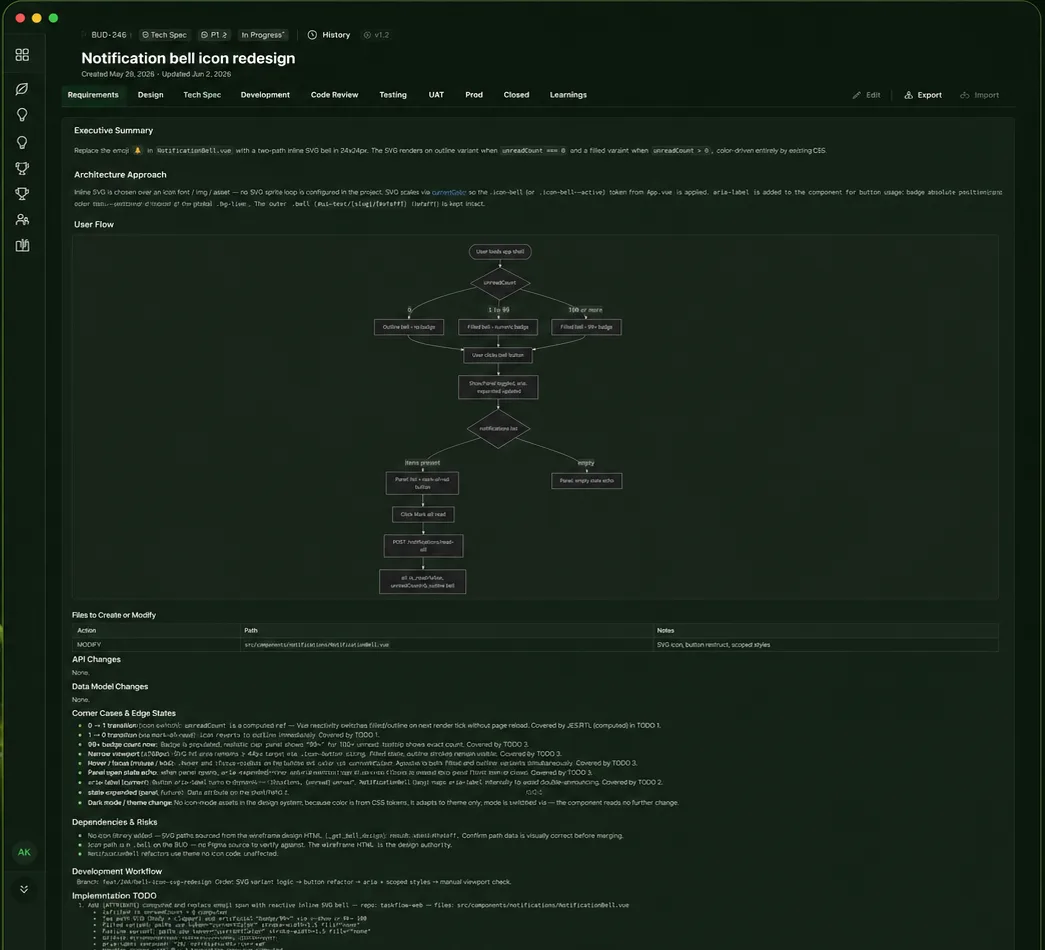
One Business Understanding Document per feature — spec, tech plan, tests, and history in a single markdown source of truth.
Your org as a tended orchard. Repos are limbs, communities are branches, recent files are leaves. Hover for context, click to drill in.
Twelve specialised agents. Today on Claude Code (codebase-aware) and the Anthropic direct API (lightweight calls); Ollama and OpenAI next. Token usage is heavily optimised.
Eight principles, deliberately echoing the Agile Manifesto's "X over Y" structure — what Bodhiorchard chooses when the trade-off is real.
Phase-by-phase flow, AI-vs-Human role split, knowledge architecture → read the full methodology
Three steps from chatter to shipped code — none of them are status meetings.
A request lands in Slack, Jira, or Linear. The Triage agent interviews the requester, checks for duplicates, and estimates complexity from your codebase.
The BUD agent writes the spec, tech plan, and test plan with full codebase context. The Design agent scopes the UI. You review and approve.
Implementation agent + your devs land the PR. On deploy, the Learning agent compares estimate vs actual and auto-links any bugs back to the originating BUD.
Want to see this end-to-end before wiring up your own codebase? Clone the repo and try the examples/ TaskFlow sample — three small repos with realistic git history that exercise scan, skill profiling, and BUD generation in one rescan.
Common questions about Bodhiorchard's positioning, privacy posture, and inference choices.
Agent-Driven Development (ADD) is a way of building software where specialised AI agents — not humans running status meetings — drive every phase of the lifecycle: intake, spec, design, tech architecture, implementation, testing, UAT, deployment, retrospective. Humans review, decide, and steer; agents do the drafting, the cross-referencing, the routine analysis, and the busywork. ADD positions itself in the same slot Agile occupied in 2001 — a methodology that absorbs the lessons of the previous era and reorganises the work around the new capabilities available. Bodhiorchard is the open-source reference implementation; the methodology is described in detail on the methodology page and is free to adopt with or without Bodhiorchard.
Yes — for the workflow layer. Bodhiorchard is the open-source reference implementation of Agent-Driven Development, which sits between IDE-side AI coding assistants (Tabby, Continue, Cursor) and traditional PM tools (Jira, Linear, Plane). It is especially relevant to teams looking for an Atlassian DC alternative — Atlassian is sunsetting new self-hosted Jira licences in March 2026 with full shutdown in 2029.
The data plane is always local — Postgres, embeddings, BUDs, scanned repos, and the audit log all sit on your hardware. Only the LLM prompts leave your machine, and only when you choose a cloud inference mode (Anthropic API key or Anthropic direct API). For fully air-gapped operation, wait for the planned Ollama preset.
Yes — paste an Anthropic API key (pay-per-token, billed by Anthropic) into Settings and the agents run via Claude Code's CLI plus the Anthropic direct API. If you already have a Claude Pro / Max subscription on your host, the Hybrid deployment mode inherits that claude login session and you pay the flat subscription rate, no per-token bills.
Those are IDE-side AI coding assistants — they help an individual developer write code. Bodhiorchard is the orchestration + project-management layer above them: it ingests requests, drafts BUDs, predicts cycle time with AI-PERT, routes work to the best-fit developer, generates test plans, links bugs back to the originating BUD, and runs the retrospective. You can pair them — write code with Tabby / Cursor in your IDE while Bodhiorchard runs the lifecycle around it.
Copilot Workspace is cloud-only and GitHub-bound — your code, planning artefacts, and history live in GitHub's cloud. Bodhiorchard is self-hosted, repo-agnostic, and AI-engine-agnostic. You can point it at GitHub, GitLab, or a self-hosted Git server, and swap inference engines without re-deploying.
Yes — via WSL2 for both deployment modes. Full Docker mode runs the whole stack inside WSL2 with no Windows host dependencies; Hybrid mode runs the host processes inside WSL2 with the infra containers backing them.
BUD = Business Understanding Document. Every feature lives in one BUD — spec, tech spec, test plan, acceptance criteria, and full history, all in markdown. It replaces the scattered combination of Jira tickets + Confluence pages + Google Docs + Notion that most teams end up with.
Apache License 2.0 — yes, commercial use is allowed, including embedding in proprietary products. Contributions require DCO sign-off (git commit -s). For deeper commercial-licence terms with proprietary integrations and support, reach out to the maintainer.
Bodhiorchard ships under Apache 2.0 because the parts of software development that matter — the thinking, the building, the shipping — shouldn't be gated behind licence audits. Use it commercially, embed it, fork it.